
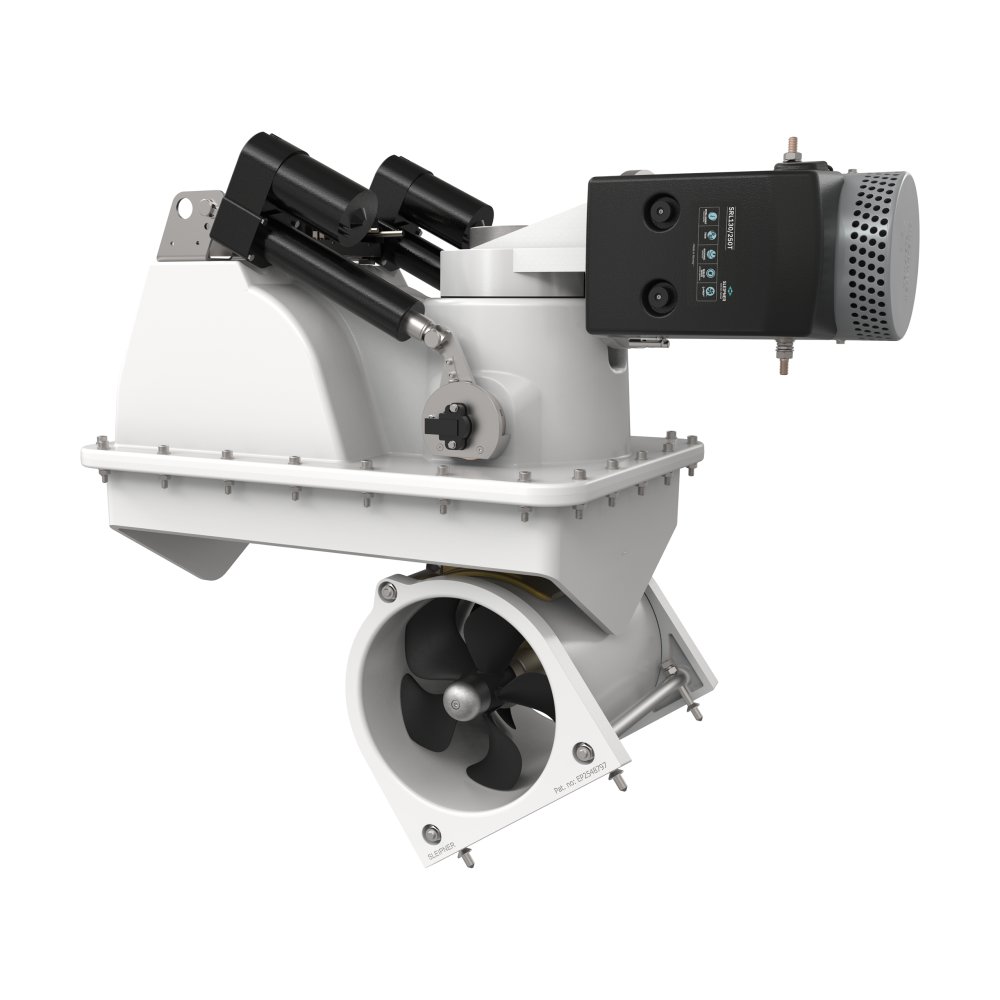
SRL130 retract bow/stern thruster 12V
Call 954-577-2850 or Send Enquiry for Pricing
SRL130 is a sturdy retract thruster with 130-160 kg thrust, suitable for boats between 42-62 feet.
The thruster is mounted on a flange and has a fast deployment and retraction time. The unit is compact with bevel gears, making it perfect for boats with limited height space.
A remote control is a popular accessory. See some of the important product and safety features below.
Product Description
Retractable thrusters cause no drag
If you have a performance boat, sail, or power, and you’re worried about the smallest amounts of drag, a retractable thruster is a perfect solution for you.
Sleipner’s retractable thrusters work with all types of propulsion systems – DC, AC, and hydraulic – and can be installed in the bow and the stern of the boat. Available as standard (on/off) or PRO™ with variable speed control extending from 80 kg to 650 kg of thrust.
Like all Sleipner products, the retractable thrusters are made with high safety standards. Safety is important in product design, from build quality to ease of installation, to ensure long-term reliability.
There are three versions of the retractable thrusters, one designed to be directly molded in and two designed to be mounted on a flange. The flange can be a mold-in base from Sleipner, or boat builders can use materials suitable for their hull or as part of their hull design.
The flange-mounted models have the thruster unit placed in a casing that can be bolted to a base. This makes installing the thrusters in hulls made from different materials easier. It also simplifies series production, as it avoids the need to mix laminating and engineering jobs.
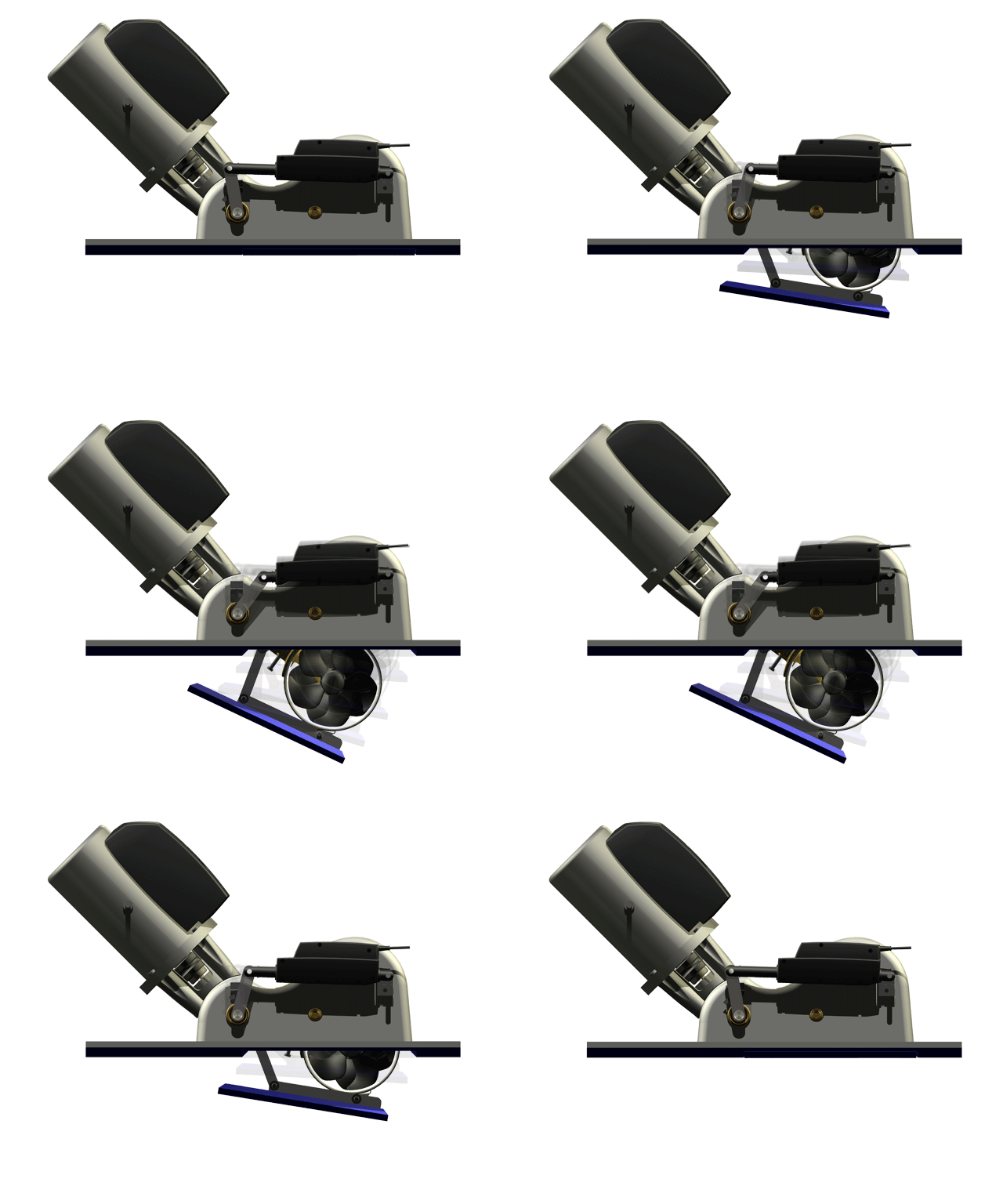
Quick deployment
The thrusters with a tunnel diameter of 185 mm use one fast and powerful actuator. In comparison, the models with a diameter of 250 mm and 386 mm have two actuators to handle the increased forces while maintaining the same exceptionally fast deployment time.
Features
- Fitted as bow and/or stern thruster
- Quiet operation
- Plug & Play S-Link™ two way communication control cable wiring
- Motor assembly rigid mounted on retracting casing: no moving parts during retracting operation
- Compact size
- Reliable retracting mechanism avoids sticking
- Fast deployment
- Easy-to-use control panel with status feedback from thruster
- Available as PRO with variable speed control
The retract mechanism
The unique design of the underwater mechanism has only a few, but very solid parts, contributing to the stability of the unit. The unit’s design makes the thruster as compact as possible while enabling safe use of heavier motors on more powerful units. The vertical installation of the motor (SRV) reduces shock forces on the unit in extreme waves compared to motors mounted at an angle.
Properties
Q-PROP™
The Q-PROP™ has measured noise reductions of up to 75% in controlled environments. The five-bladed skew propeller reduces noise levels while maintaining exceptional efficiency. Some thruster models even see an increase in thrust power.
- The expected noise reduction in average installations: 20-40%
- Upgrade kits are available for most Sleipner thruster models with special adaptors
INTELLIGENT POWER CONTROL
Sleipner’s patented intelligent power control provides a minimal delay between drive directions to reduce wear of the mechanical parts while monitoring solenoid functions. In the case of a solenoid lock-in, the thruster will automatically stop without extra user action or controlling the main switch.
OVERHEAT PROTECTION
When high temperatures are detected, On/off thrusters are automatically shut off to prevent overheating. PRO™ thrusters with speed control provide extended run-time by derating power to maintain temperature within safe levels.
ANALOG
Sleipner analog signal cables with Plug & Play connectors are color-coded to match the wiring diagrams with high-quality connectors to ensure a correct installation.
SEALED DRIVE LUBRICATION
The thruster gearleg is pre-filled for lifetime lubrication and sealed using a long-time mechanical seal with ceramic and carbon surfaces for ultimate security against water intrusion.
FLEXIBLE COUPLING
Flexible coupling protects the product’s driveline by compensating for minor misalignments between the shafts of the thruster motor and gearleg.
TWIN PROPELLERS
Twin propellers can provide more thrust than a single propeller system in the same tunnel diameter. We use this system in our mid-range models, where high thrust is required in small tunnel diameters. Due to the compact design and high performance, the twin models have become the thrusters of choice among boatbuilders worldwide.
| ⚙️ Main power | |
| Power supply | 12V DC |
| Nominal voltage | 10.5V DC |
| Current consumption A | 800A |
| Power output at nominal voltage | 6.5kW / 8hp |
| Recommended fuse A | ANL 500 |
| ❄️ Cold Cranking Amps (CCA) | |
| Minimum battery CCA (DIN) | 750 |
| Minimum battery CCA (SAE) | 1425 |
| Minimum battery CCA (EN) | 1320 |
| 🚤 Performance & features | |
| Motor cycle duty | 2 – 3 min. Duty cycle at 20°c (Ambient temperature) |
| 📊 Thrust ratings | |
| Thrust at 12V | 160kg / 352lbs |
| Thrust at 10.5V | 130kg / 286lbs |
| 🧩 Features | |
| Intelligent Power Control | Yes |
| Q-Propeller | Yes |
| Twin Propellers | Yes |
| Sealed Drive Lubrication | Yes |
| Analog | Yes |
| Overheat Protection | Yes |
| Flexible Coupling | Yes |
| Ceramic Seals | Yes |
| SRL_high__d_3rXp9aO.png | SRL_high__d_3rXp9aO.png |
| SRL_high__d_3rXp9aO.png | SRL_high__d_3rXp9aO.png |
| 📏 Dimensions | |
| (H) Height | 389mm / 15in |
| (+H) Additional Height | 49mm / 1in |
| (L) Length | 687mm / 27in |
| (+L) Additional Length | 264mm / 10in |
| (W) Width | 480mm / 18in |
| (ID) Internal Diameter | 250mm / 9in |
| (RD) Retract Depth | 374mm / 14in |
| (RW) Retract Width | 348mm / 13in |
| (MW) Mould Width | 420mm / 16in |
| (MH) Mould Height | 97mm / 3in |
| (CT) Cable Terminal | M8 |
| 🔧 Installation capability | |
| Bow Capability | Yes |
| Stern Capability | Yes |
| Retractable Capability | Yes |
| ⛵ Ideal vessel integration | |
| Typical vessel class | Motor boat, Sail boat |
| Typical vessel size | 13-19m / 42-62ft |
| ⚖️ Product weight | |
| Net weight | 82kg / 180lbs |
Are Lithium-ion (Li-ion), LiFePO4 or Lithium batteries a good solution for thruster battery banks?
Not necessarily. These systems typically come with a Battery Management System (BMS) that will disconnect the thruster in case of any issue with the battery (for instance, if the thruster draws more current than the BMS allows). Just imagine a sudden cut-out in the middle of a maneuver without any pre-warning.
At Sleipner, we recommend a solution with a simple, separate battery and without a disconnect BMS system (such as the lead acid bank frequently used for starting or similar). The helmsman will then be warned when the battery is getting low and feel that the thrusters are gradually losing power, which is significantly better than losing your thrusters without any pre-warning.
Disclaimer: Ensure battery/energy source is installed according to CE/ISO current rules and regulations and by licensed electricians.
Can I use LiFePO4, Lithium or Lithium-ion batteries for my thrusters?
Yes, you can, but not without taking some precautions. Sleipner produces two product lines of thrusters that will work well with high-capacity batteries and one product line which should be used with caution in combination with LiFePO4, Lithium, Li-ion, or similar batteries, which may be capable of delivering higher voltage under load than traditional batteries (such as lead-acid, AGM, gel or similar).
All Sleipner proportional thrusters will work well with Li-ion or LiFePO4 batteries, as the included PPC unit will control the output voltage to a safe level for the thruster. Make sure, though, that you actually get a good battery intended for maritime use. NB – make sure you have the latest embedded software installed.
All Sleipner eVision thrusters have built-in functionality to limit the maximum voltage delivered to the thruster. Again, make sure your battery is intended for maritime use.
Traditional DC on/off thrusters may be damaged or have a reduced life expectancy if operated at voltage levels outside their specifications.
Disclaimer: Ensure battery/energy source is installed according to CE/ISO current rules and regulations and by licensed electricians.
Can the thruster cause the BMS (Battery Management System) to disconnect the batteries?
Yes. Most engineers would tell you that it is not ideal for connecting the bow thrusters to a service bank protected by a Battery Management System. Thrusters are heavy consumers, and they may create sudden peaks in current draw, which again may cause the BMS to disconnect the batteries if the thruster draws more current than allowed. If this happens in the middle of a maneuver, you would be left without thrusters and may lose control of the boat.
Hence, Sleipner recommends that the thrusters be connected to a separate battery bank (that is not lithium) without a Battery Management System that can disconnect the batteries (and consequently the thrusters).
Disclaimer: Ensure battery/energy source is installed according to CE/ISO current rules and regulations and by licensed electricians.
What is IPC (Intelligent Power Control)?
This is a unique patented Sleipner safety feature supplied with all standard (on/off) DC electric Sleipner thrusters. The IPC functionality provides two unique features:
- It will detect “flapping” of the solenoid (typically caused by badly charged batteries that are subject to a huge current draw and voltage drop when the thruster motor is engaged), and will stop trying to run the thruster, preventing excess solenoid contact tip wear and dramatically reducing the risk for a weld-in situation of the solenoid. A ‘weld in’ (run away) situation is when a thruster continues operating without a signal from the operator at the control panel.
- Even if the solenoid has a weld-in situation, which even with the IPC prevention actions is still possible, as all mechanical switches can weld-in at a point, the unique IPC function will STOP THE THRUSTER, without active action by the operator. This will give the operator time to locate and Select OFF on the thruster system Isolation/Main Switch.
What type of batteries are recommended for thrusters?
Sleipner recommends that the thrusters are connected to a battery bank that is not protected by a Battery Management System (BMS). Typically this means lead-acid, AGM, gel, or similar kinds of batteries. This is important because thrusters draw a lot of currents quickly, and the high amp draw may lead the BMS system to think that there is an issue with the system and consequently disconnect the batteries from the circuit, in which case you would lose maneuverability.
If you have Lithium batteries powering your thrusters, the best advice we can give you is to check the actual voltage measured on the thrusters during operation. Sleipner thrusters are designed to operate within a specific voltage range, and as long as you are within these boundaries, it doesn’t matter for the thruster if the current is delivered by this or that battery pack.
It may also be a very good idea to check the actual current drawn from the battery during full power at the thruster to see that you are not at the limit for the BMS to avoid sudden loss of maneuverability if the BMS disconnects the battery.
With installations where the battery pack is far from the thruster, the higher voltage delivered by LiFePO4 or similar batteries might not be a problem as you will experience a voltage drop through the long cables.
Always make sure you measure your voltage on the thruster to avoid the risk of early thruster wear.
As battery technology is changing rapidly, we always recommend consulting a professional battery supplier.
Disclaimer: Ensure battery/energy source is installed according to CE/ISO current rules and regulations and by licensed electricians.
Related products
-
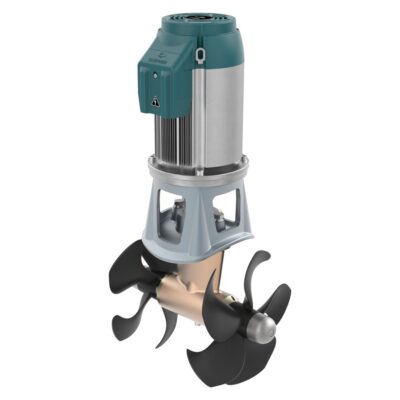
E420 eVision tunnel bow/stern thruster 48V
Call 954-577-2850 or Send Enquiry for Pricing More Info -
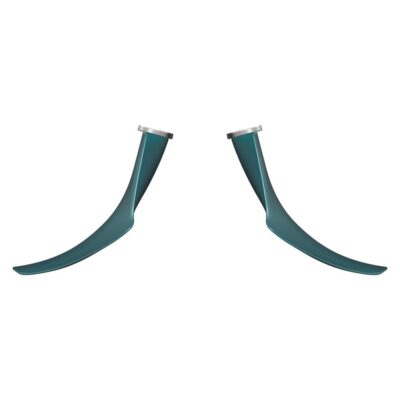
Vector Fins™ pair – for SPS100E Electric actuator
Call 954-577-2850 or Send Enquiry for Pricing More Info -
Vector Fins™ 1,05m² for hydraulic actuator SPS66/67
Call 954-577-2850 or Send Enquiry for Pricing More Info -

SPS60E DC Electric stabilizer actuator
Call 954-577-2850 or Send Enquiry for Pricing More Info